
Policy Outcome Model Design
Context
Policy evaluation needs to return something the gateway can act on. Binary allow/deny works for firewalls, but enterprise AI needs more nuance.
Real scenarios:
- Trader asks about a restricted security → BLOCK immediately
- Analyst pastes a document with PII → STRIP the PII, then allow
- Junior employee drafts client communication → PAUSE for senior review
- Normal query → ALLOW through
Binary forces us to either block everything risky or allow everything and handle edge cases downstream.
Decision
Four outcomes: ALLOW, BLOCK, REDACT, ESCALATE
Each outcome applies to both input and output policies:
- Input policies evaluate the request before it hits the LLM
- Output policies evaluate the LLM response before returning to user
- Same outcome model, different checkpoint
Outcome definitions:
- ALLOW: Request/response proceeds unchanged
- BLOCK: Stops flow immediately. Returns error to user. Logged with reason.
- REDACT: Returns new content (does not mutate original). Sensitive data replaced with tokens (e.g., [REDACTED:PII:ref_4821]). Original stored in secure lookup table. Flow continues with redacted version.
- ESCALATE: Synchronously blocks and creates review queue entry. Request suspended until human approves/rejects. If approved, flow resumes from where it paused. If rejected, treated as BLOCK.
Outcome precedence (when multiple policies fire):
- BLOCK (most restrictive, stops everything)
- ESCALATE (requires human decision)
- REDACT (modifies but allows)
- ALLOW (least restrictive)
If input policy says REDACT and output policy says BLOCK → BLOCK wins.
Flow diagram:
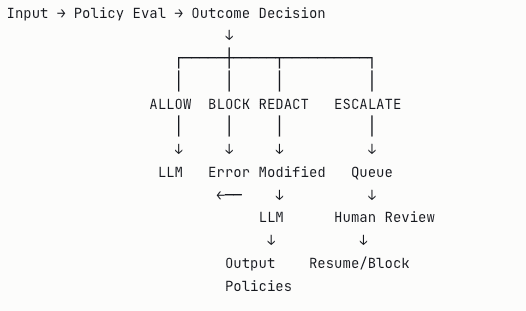
LLM Response → Policy Eval → Outcome Decision → [ALLOW/BLOCK/REDACT/ESCALATE] → User
Alternatives Considered
Binary model (ALLOW/BLOCK only):
Rejected because redaction and human review would need separate middleware. Trade-off: 2x complexity for 4x expressiveness.
Six outcomes (adding WARN and DEFER):
Rejected because WARN can be logged without being a distinct outcome, and DEFER (rate limiting) belongs at the gateway layer. Trade-off: Less granularity for simpler mental model.
Outcome combinations (REDACT + ESCALATE):
Rejected because it creates combinatorial explosion and unclear semantics. Trade-off: Single outcome per evaluation. Chain policies if you need both.
Async ESCALATE:
Rejected for v1 because it requires distributed workflow engine and complex timeout handling. Trade-off: Synchronous blocking for simplicity. Will revisit at scale.
Consequences
Wins:
- Human review is first-class (ESCALATE)
- Data sanitization happens at policy layer (REDACT)
- Clear precedence rules prevent conflicts
- Immutable redaction (returns new content, doesn't mutate)
- Same model works at both checkpoints
Costs:
- 4 code paths instead of 2
- ESCALATE blocks synchronously (can't scale to millions of concurrent escalations)
- Gateway must handle precedence logic
- Testing matrix: 4 outcomes × 2 checkpoints = 8 paths minimum
When to revisit:
If ESCALATE becomes async (would change entire queue architecture)
If 90%+ of policies only use ALLOW/BLOCK
If we need outcome combinations (REDACT + ESCALATE simultaneously)